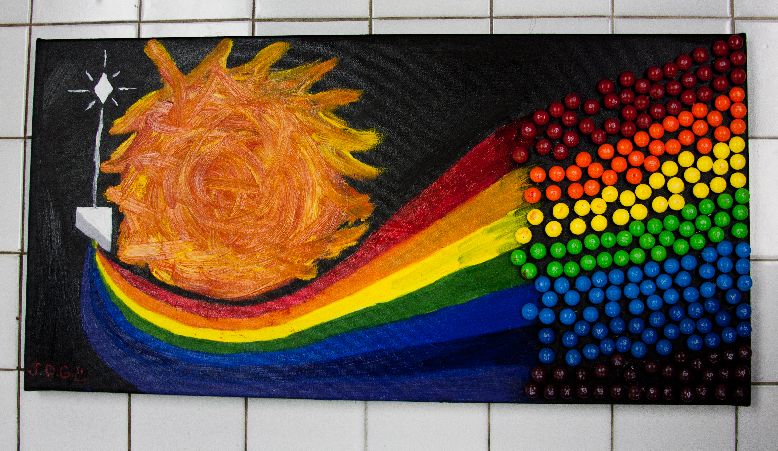
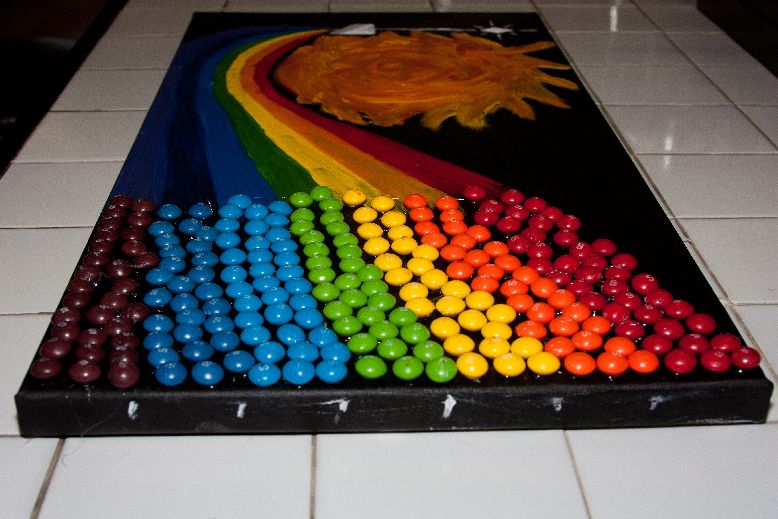


This piece is meant to show several ideas present in the scientific world. These include the separation and diffraction of light through a prism, Einstein's General Theory of Relativity, Eddington's experiment, and Einstein's Photoelectric Effect.
One of the ideas represented in this work is the fact that light can be broken into its basic colours by shining it through a prism. White light, as from a star, is made up of seven different colours: red, orange, yellow, green, blue, indigo, and violet, which can be seen through the use of a prism. These colours are diffracted at different angles depending on their wavelength; the longer the wavelength the more that colour is bent as it comes out of the prism. The colour red, which is the longest visible wavelength, is bent the most, while violet, which is the shortest visible wavelength, does not diffract as much. This is represented by the star emitting white light into the prism, which in turn is diffracting the colours of the rainbow.
This piece also expresses Einstein's General Theory of Relativity. This theory states that the fabric of space is bent or warped by large masses such as the sun, creating a crater around it which determines the orbit of the smaller masses around it, such as the planets. According to Eddington's experiment, light is affected by this gravitational pull as well and is therefore bent when it passes the sun, as during a solar eclipse. In this piece this is expressed (perhaps in a slightly exaggerated manner) by having the separated and diffracted light bend around the sun as it leaves the prism.
This piece of art also expresses Einstein's Photoelectric Effect. In this experiment, Einstein beamed radiant energy (light) at a metal plate. The light with shorter wavelengths (and therefore more energy) emitted electrons which were attracted to the positive terminal of the power source. This demonstrated that light could behave both as waves and as particles. This is demonstrated in my artwork by having the wave-like rainbow disintegrate into Skittles, which represent light as particles.